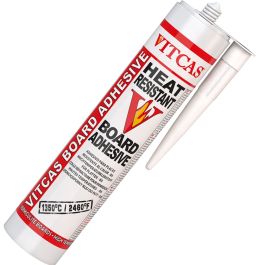
Board Adhesive, sold as Vitcas BA board adhesive, is used for specific panel connections and their attachment to a compatible substrate. The key question is: does the selected panel, surface, and joint size match this variant of adhesive? The temperature resistance alone does not determine the method of installation.
When is BA in a cartridge suitable?
Vitcas BA 310 ml adhesive is a ready-to-use compound for applications described in the manufacturer's datasheet. It specifies the joining of appropriate panels and attachment to a flat wall or blocks when the gap does not exceed 5 mm. For larger irregularities, the manufacturer indicates an alternative solution with HB60 adhesive.
This limit does not mean that every joint with a 5 mm gap will be appropriate. It is also necessary to check the recommended joint geometry, surface preparation, and method of support. The requirements for the panel and the entire enclosure still apply.
BA and HB60: why are they not the same?
BA in a cartridge makes it easier to apply the ready-to-use compound to the intended joint. HB60 is a different product, with different bonding properties and applications. For an uneven substrate, BA should not be chosen solely because it was left over from a previous repair.
Similarly, a 310 ml package and a larger container do not exempt you from checking the data sheet of the specific variant. Read the parameters and operating method from the correct documentation, not from the instructions of a random heat-resistant adhesive.
Preparing the connection
Dry-fit the panels. Remove dust from cutting and assess the stability of the substrate. Plan the support for elements and fastenings, if required. Before application, check whether the panel needs edge preparation or priming.
During drying, secure the elements against shifting. Maintain the working temperature and time before finishing and the first heating. Do not seal expansion joints or ventilation openings. Enclosure adhesive is not automatically adhesive for every part inside the fireplace nor a way to repair poorly designed support.